
Promote your contents FREE, contents such as WebSites, YouTube channels, YouTube videos, Facebook, Instagram, LinkedIn, Twitter, Pinterest and many more.
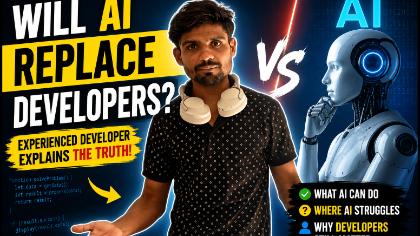
Will AI replace developers? An experienced developer shares insights on AI's true role in coding, job security, and the evolving tech landscape. Discover how to adapt and thrive.
Opening content automatically in secounds...
Or
This content was added on Promote Content at 20 Jun 2026 and got 13 visits untill now.
The rapid advancement of artificial intelligence has sparked a pervasive question across many industries: "Will AI replace my job?" For software developers, this query is particularly resonant. With AI models now capable of generating code, debugging, and even designing basic applications, the fear that machines might entirely usurp human programmers is understandable. However, as an experienced developer who has witnessed countless technological shifts, I believe the narrative of complete replacement is a simplistic and ultimately misleading one. The reality is far more nuanced; AI isn't coming to replace developers, but to redefine and augment our roles. ### The Hype vs. The Reality of AI in Development There's no denying AI's impressive capabilities. Tools like GitHub Copilot, ChatGPT, and other AI-powered assistants can generate boilerplate code, suggest functions, refactor existing code, and even identify potential bugs faster than any human. This automation of repetitive and predictable tasks is undeniably powerful. It significantly boosts productivity, allowing developers to complete routine work in a fraction of the time. However, it's crucial to understand that these tools operate within defined parameters, relying on vast datasets of existing code. They are excellent at pattern recognition and replication but often struggle with genuine innovation, abstract problem-solving, or understanding the subtle, unarticulated needs of a human user or a complex business context. ### Where AI Excels and Where Human Developers Remain Indispensable AI excels in areas of optimization, pattern matching, and automating the mundane. Need to convert a function from one language to another? AI can help. Want to generate unit tests for a specific module? AI is a great assistant. But software development is far more than just writing lines of code. It involves a deep understanding of domain knowledge, strategic planning, critical thinking, and creative problem-solving. These are the realms where human developers continue to be indispensable. Consider the initial stages of a project: understanding ambiguous requirements, translating vague business goals into technical specifications, designing complex architectures, or navigating political landscapes within an organization. These tasks require empathy, intuition, negotiation skills, and a holistic view that AI currently lacks. Furthermore, debugging complex, interconnected systems, especially those with legacy code or unpredictable edge cases, often demands human ingenuity to trace abstract issues, rather than just pattern recognition. ### The Evolving Role of the Developer: From Coder to Architect The advent of AI doesn't spell the end of the developer; instead, it signals an evolution of the role. We are transitioning from being primarily coders to becoming architects, strategists, and orchestrators of intelligent systems. Our focus will shift from the mechanics of writing every line of code to designing sophisticated systems, defining problems effectively, validating AI-generated solutions, and integrating AI tools seamlessly into our workflows. Developers will become "AI whisperers" – experts at crafting prompts, understanding AI's limitations, and guiding it to produce optimal results. This shift means less time spent on tedious, repetitive coding and more time dedicated to higher-value activities: complex problem-solving, system design, performance optimization, security considerations, and ensuring the ethical deployment of technology. We'll be freed up to tackle the truly challenging and creative aspects of software engineering that contribute most to business value and user experience. ### Essential Skills for the Future-Proof Developer To thrive in this AI-augmented future, developers must cultivate a new set of skills, or rather, elevate existing ones: 1. **Critical Thinking and Problem Solving:** AI can generate solutions, but a human must define the problem, evaluate the solution's efficacy, and identify potential pitfalls. 2. **Creativity and Innovation:** AI is a tool for execution; humans are the source of novel ideas and innovative approaches to user experience and system design. 3. **Domain Expertise:** A deep understanding of the business context or industry specific to the software being built allows developers to guide AI effectively and ensure solutions are relevant and valuable. 4. **Adaptability and Lifelong Learning:** The tech landscape is constantly changing. Developers must be proactive in learning new AI tools, understanding their underlying principles, and adapting their workflows. 5. **Communication and Collaboration:** Working effectively with non-technical stakeholders, product managers, and other team members to translate abstract needs into concrete technical specifications remains paramount. AI cannot replace human-to-human interaction and negotiation. 6. **Prompt Engineering:** Understanding how to effectively communicate with AI models to elicit the desired code or information will become a crucial skill. ### Collaboration, Not Competition Ultimately, AI should be viewed as a powerful collaborator, not a competitor. It's a force multiplier that can augment human capabilities, allowing developers to be more productive, efficient, and innovative than ever before. By offloading repetitive tasks to AI, developers can focus on the more challenging, rewarding, and uniquely human aspects of their work – the creative spark, the strategic vision, and the deep understanding of human needs that truly drive technological progress. ### Conclusion: The Future is About Evolution, Not Extinction The question isn't whether AI will replace developers, but how developers will integrate AI into their toolkit to build better, more sophisticated software. The developer's role is not diminishing; it is evolving. Those who embrace AI as a partner, who focus on higher-level problem-solving, critical thinking, and continuous learning, will not only remain relevant but will lead the charge in shaping the next generation of technology. The future of software development is a collaborative symphony between human ingenuity and artificial intelligence, and it promises to be more exciting and impactful than ever before. So, to my fellow developers: fear not the machine, but learn to master it, for in doing so, you secure your indispensable place in the digital age.